Woods Practical Guide to Fan Engineering
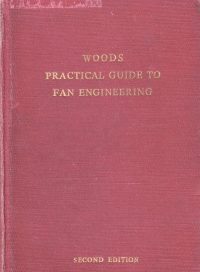
A Classic Reference That Has Educated Generations of Ventilation Engineers
LEVCentral Expert Commentary
Few books have achieved the reputation within the ventilation industry enjoyed by Woods Practical Guide to Fan Engineering. First published by Woods of Colchester in 1952, the book became one of the standard reference texts for ventilation engineers throughout the UK and internationally. It was subsequently enlarged, reprinted and revised several times, with the extensively revised third edition being published in 1978 under the editorship of B. B. Daly, former Technical Director of Woods of Colchester.
Although its title suggests a book solely about fans, that significantly understates its scope. The guide is a comprehensive textbook covering many aspects of ventilation engineering, including airflow, duct systems, pollution control, heating, cooling, acoustics, energy efficiency and industrial ventilation. It was written for both practical engineers and professional designers, combining engineering theory with numerous worked examples and practical design guidance.
For LEV professionals, the book remains surprisingly relevant. While modern standards, regulations and fan technology have evolved considerably since its publication, the fundamental principles of airflow and fan performance have not changed. Engineers wishing to understand why ventilation systems behave as they do will still find much of value within its pages.
Today the book is long out of print but good second-hand copies regularly appear through specialist booksellers, eBay, AbeBooks and occasionally Amazon, often at very reasonable prices.
Where to Find a Copy
As the book is no longer in print, copies are normally available from second-hand book dealers.
Common sources include:
- eBay
- AbeBooks
- Amazon Marketplace
- Specialist engineering book dealers
Availability varies, but copies frequently appear at modest prices.
Key Learning Points
The book covers a remarkably broad range of ventilation engineering topics, including:
- General Ventilation
- Air Distribution and Circulation
- Heating and Cooling of Buildings
- Pollution Control
- Air Flow and Pressure in Ducted Systems
- Fans and Fan Performance
- Fan Drives and Fan Control
- Fan Duty Control and Energy Saving
- Noise, Vibration and Fatigue
- Fan Testing and Performance Prediction
- Air in Heat Exchange and Drying
- Ventilation of Tunnels and Mines
In addition, the text contains numerous worked examples, engineering charts, performance curves and practical design information that remain useful today.
Source Document Information
Title: Woods Practical Guide to Fan Engineering
Original Publisher: Woods of Colchester Ltd.
First Published: 1952
Later Editions: Second Edition (1960), Third Edition (1978, revised by B. B. Daly), with subsequent reprints into the late 1980s and early 1990s.
Document Type: Engineering Reference Book
Primary Topics: Fans, Ventilation Engineering, Airflow, Duct Design, Pollution Control, Fan Testing, Energy Efficiency
Audience: LEV Designers, Mechanical Engineers, Building Services Engineers, Occupational Hygienists, Commissioning Engineers and Engineering Students.
LEVCentral Perspective
Despite being more than seventy years old, this remains one of the most respected books ever written on practical ventilation engineering.
Its enduring popularity stems from the fact that it teaches engineering principles rather than product specifications. Whilst modern fan efficiencies, legislation and standards have changed, the relationships between airflow, pressure, system resistance and fan performance remain fundamentally the same.
Perhaps the greatest surprise for many readers is that this is not simply a fan book. It is really a broad textbook on ventilation engineering that uses fans as the means of delivering airflow. Subjects such as pollution control, duct pressure losses, building ventilation, energy saving and acoustics make it equally valuable to LEV specialists and building services engineers.
For anyone studying advanced LEV design, the book provides valuable background knowledge that complements more modern references such as HSG258, the ACGIH Industrial Ventilation Manual and current standards. It explains not only how fans are selected, but why ventilation systems behave as they do.
Further Resources
- ACGIH – Industrial Ventilation: A Manual of Recommended Practice for Design
- HSG258 – Controlling Airborne Contaminants at Work
- Industrial Hygiene Control of Airborne Chemical Hazards – Popendorf
Recommended Learning
- P600 Methods for Testing Performance of LEV
- P601 LEV Thorough Examination & Testing
- P602 LEV Basic Design Principles
- P604 LEV Commissioning & Performance Evaluation
Thought Leadership
Some engineering books become outdated because they describe obsolete equipment. Others become classics because they explain principles that never change.
Woods Practical Guide to Fan Engineering belongs firmly in the second category.
Long before computer modelling, CFD analysis and smartphone apps, engineers designed highly effective ventilation systems using the knowledge contained within books such as this. The mathematics may sometimes be more demanding than modern texts, but the engineering thinking remains refreshingly clear.
For LEV professionals, this book also serves as a reminder that understanding fans alone is not enough. Successful ventilation depends on the interaction between the hood, ductwork, system resistance, fan, discharge arrangements and the contaminant itself.
By treating the ventilation system as a complete engineering system rather than a collection of components, the guide continues to offer lessons that are every bit as relevant today as when it first appeared in 1952.
If you come across a good second-hand copy, it is well worth adding to your engineering library—not simply as a collector’s item, but as one of the classic texts that helped shape modern ventilation engineering.

