Wake Effect – Partial Enclosures
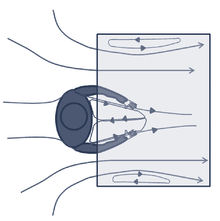
The Wake Effect is well known and indeed it is covered at some length in HSE’s Guidance Note HSG258 (Controlling Airborne Contaminants in the Workplace.
Have just come across this published research paper from 1994 which considers the Wake Effect in detail
HSE Demonstration Video – Wake Effect at Partial Enclosures
Wake Effect with no sah and Face Velocity = 0.3m/s
Wake Effect with Sash and Face Velocity = 0.5m/s
Abstract—Wake Effect – Boundary layer separation leads to the formation of a wake region downstream of a worker in an air flow field. This fundamental phenomenon is responsible in many cases for compromising the intended beneficial effect of ventilation designed to reduce worker exposure to toxic airborne substances.
A review of some simple mathematical models to describe the impact of wakes on exposure is presented along with some field studies illustrating the effect.
The importance of flow visualization to detect and correct the problem cannot be overstated.
The research suggests that work practices in many cases are as important as the ventilation design in achieving successful control, and that a well designed local exhaust system must include an understanding of how the worker performs the job
Source Abstract
Source: British Occupational Hygiene Society (BOHS)
Document Type: Research Paper
Status: 1995
Last reviewed by LEVCentral: June 2026
Why This Guidance Matters
Many people assume that if air is flowing towards an extraction system, contaminants will automatically move away from the worker.
Unfortunately, airflow around the human body is rarely that simple.
As air moves around a person standing at a partial enclosure, airflow separates around the body and creates a turbulent recirculation zone behind them. This is known as the Wake Effect. Research has shown that these wake regions can significantly influence contaminant movement and may compromise the intended protection provided by ventilation systems.
In practical terms, contaminants that should have been drawn safely into the enclosure can instead be pulled into the worker’s breathing zone.
Understanding the Wake Effect
The Wake Effect is similar to the turbulence that forms behind a moving vehicle.
As airflow encounters the worker’s body it cannot pass directly through it. Instead, the airflow separates around the sides and creates an area of lower pressure behind the person.
This turbulent region can:
- Draw contaminants towards the worker
- Increase breathing zone concentrations
- Reduce containment performance
- Disturb otherwise stable airflow patterns
The phenomenon is particularly important when workers lean into partially enclosed processes or position their heads close to enclosure openings.
Partial Enclosures and Worker Exposure
Partial enclosures are widely used throughout industry because they offer a practical balance between accessibility and containment.
Examples include:
- Laboratory fume cupboards
- Spray booths
- Welding booths
- Glovebox access openings
- Bench-top extraction enclosures
- Powder handling enclosures
However, whenever an operator stands directly in front of an enclosure opening there is the potential for wake formation.
Even where face velocities appear satisfactory, the airflow pattern may still be adversely affected by operator position, body movement or external draughts. HSG258 specifically discusses the importance of maintaining stable airflow and avoiding conditions that compromise contaminant capture.
The Value of Smoke Visualisation
One of the most effective ways of demonstrating the Wake Effect is through smoke testing.
Smoke visualisation allows otherwise invisible airflow patterns to be observed in real time.
The HSE video associated with this topic demonstrates how smoke released near a partial enclosure can be drawn into turbulent recirculation zones created by a worker standing at the opening.
This type of demonstration is often far more persuasive than airflow measurements alone because it allows operators to see how their own position influences contaminant movement.
As noted in the original research referenced by LEVCentral, the importance of flow visualisation in identifying and correcting wake-related problems cannot be overstated.
Practical Control Measures
The Wake Effect cannot always be eliminated, but its impact can often be reduced through good design and working practices.
Examples include:
- Increasing enclosure depth where practical
- Improving enclosure design
- Reducing unnecessary access openings
- Positioning contaminant sources further inside the enclosure
- Avoiding excessive operator intrusion into the workspace
- Managing cross-draughts and room air currents
- Using smoke visualisation during commissioning and testing
These measures can help maintain stable airflow and improve contaminant containment.
Key LEVCentral Takeaways
- The Wake Effect is caused by airflow separation around the worker’s body.
- Turbulent wakes can draw contaminants into the breathing zone.
- Partial enclosures are particularly susceptible to wake effects.
- Good face velocity alone does not guarantee effective containment.
- Worker position can significantly influence exposure levels.
- Smoke visualisation is one of the best methods of identifying wake-related problems.
- The Wake Effect should be considered during LEV design, commissioning and testing.
- Understanding airflow behaviour is often more important than simply measuring airflow quantity.
Further Resources
Related LEVCentral Resources:
Recommended Learning
- M200 Basic Principles of Occupational Hygiene
- M505 Control of Hazardous Substances
- P600 Methods for Testing Effectiveness of LEV
- P601 Thorough Examination and Testing of LEV Systems
- P602 LEV Design Principles
- P604 Performance Evaluation and Management of LEV Systems
Thought Leadership
The Wake Effect serves as an important reminder that exposure control is not simply about moving air—it is about understanding how air actually behaves around people.
Many ventilation systems achieve their design airflow rates yet still fail to provide optimum protection because airflow patterns have not been properly considered. By visualising airflow and understanding how workers interact with ventilation systems, designers and testers can often identify issues that would never be detected through airflow measurements alone.
For this reason, smoke visualisation remains one of the most valuable tools available to LEV professionals, occupational hygienists and anyone seeking to understand the real-world performance of exposure control systems.

