OXYL8 LEV Calculation App – Free Captor Hood and LEV Engineering Toolkit
Resource Summary
Free LEV Design and Assessment Tools for Apple and Android Devices
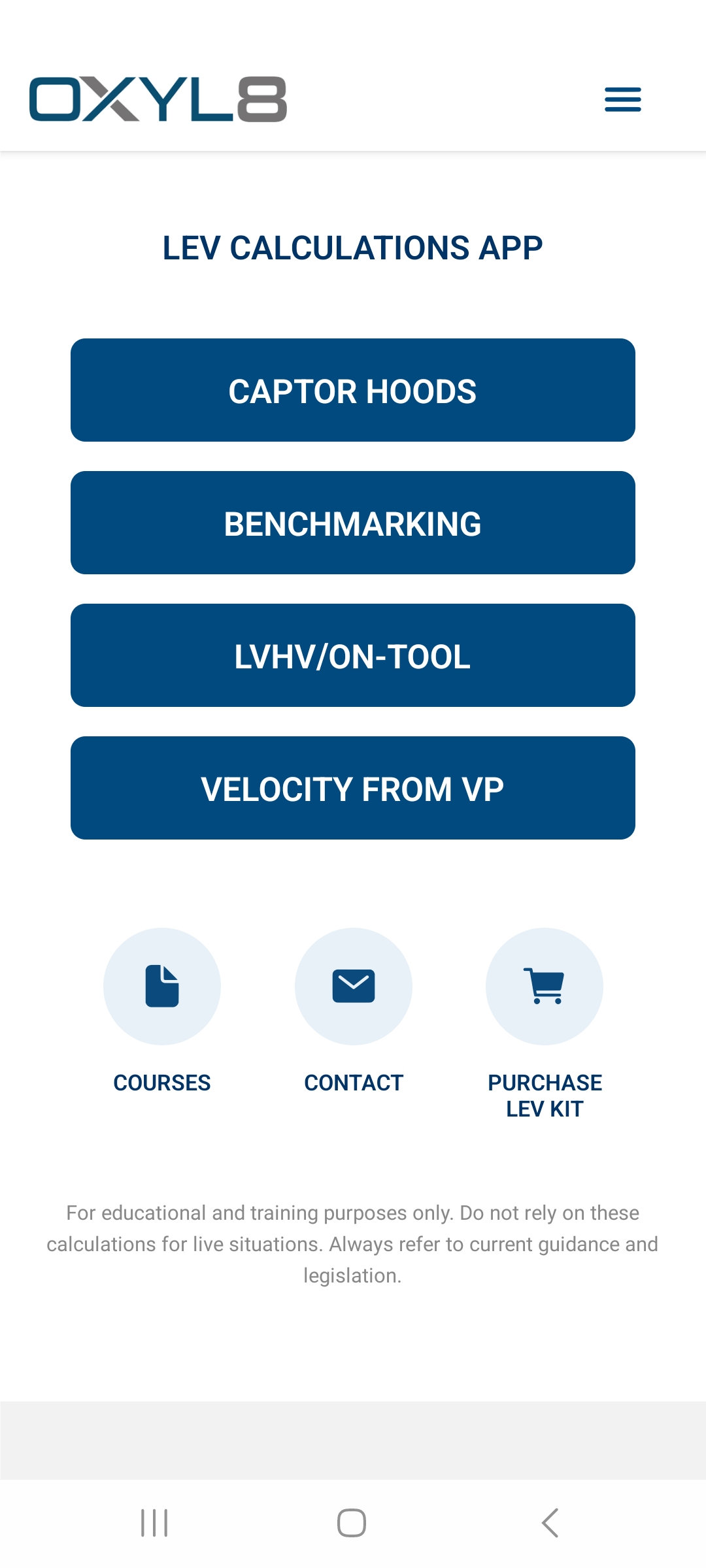
The OXYL8 LEV Calculation App is a free mobile application developed specifically for LEV professionals, occupational hygienists and engineers involved in the design, assessment and testing of Local Exhaust Ventilation systems.
Originally developed as a Captor Hood calculation tool using Fletcher’s Equations, the App has evolved into a practical field-based engineering toolkit incorporating several commonly used LEV calculations and benchmarking functions. The App is available free of charge for both Apple and Android devices.
The App includes tools for:
- Captor Hood calculations
- Effective captor distance calculations
- Hood entry velocity calculations
- Benchmark calculations
- LVHV test-kit calculations
- Velocity pressure (Vp) to transport velocity (Vel) calculations
- LEV field assessment support
The App has become widely used throughout the LEV profession and is frequently utilised by:
- LEV Designers
- LEV Consultants
- P601 TExT Engineers
- Occupational Hygienists
- Commissioning Engineers
- LEV Trainers
- Students undertaking BOHS qualifications
- Duty Holders reviewing LEV performance
Source Document
Download information can be found in your phone App Store by typing in the search window “OXYL8”:
Source: OXYL8 Ltd
Document Type: Mobile Application
Platform: Apple iOS and Android
Cost: Free
Status: Current
Last reviewed by LEVCentral: June 2026
LEVCentral Expert Commentary
One of the challenges faced by LEV professionals is that many engineering calculations are undertaken away from the office.
Whether conducting a site survey, designing a new installation, commissioning a system or carrying out a Thorough Examination and Test (TExT), engineers often need rapid access to reliable calculations without returning to spreadsheets, textbooks or desktop software.
The OXYL8 App was developed to address this need.
The original module utilised Fletcher’s Equations to calculate the relationship between hood dimensions, face velocity and effective captor distance. The App supports calculations for:
- Round hoods
- Rectangular hoods
- Slot hoods
- Oval hoods
allowing engineers to quickly assess whether a proposed hood arrangement is likely to achieve effective contaminant capture.
Over time, additional modules have been added to support common LEV field calculations including benchmarking and velocity calculations. Recent versions also include LVHV-related calculation tools and enhanced benchmarking functions.
From a LEVCentral perspective, one of the most valuable aspects of the App is that it encourages engineers to think about capture performance rather than simply airflow.
This reflects an important occupational hygiene principle:
Airflow only becomes valuable when it effectively captures contaminants before they enter the worker’s breathing zone.
The App therefore supports better engineering decision-making whilst promoting good LEV design practice.
Key Learning Points
Effective Capture Is More Important Than Airflow Alone
The purpose of an LEV system is to capture contaminants before they reach the worker. Captor distance calculations help engineers understand whether this objective is likely to be achieved.
Fletcher’s Equations Remain Widely Used
The App uses Fletcher’s Equations to assist with the assessment and design of captor hoods and source-capture ventilation systems.
Field Calculations Improve Decision Making
Rapid access to engineering calculations can support better commissioning, troubleshooting and design decisions during site visits.
Benchmarking Supports Ongoing Performance Assessment
Benchmark calculations allow engineers to compare current system performance against historical reference values and identify deterioration over time.
Practical Tools Support Better LEV Outcomes
The App provides a convenient way of applying established engineering principles during real-world LEV assessments.
App Features
Captor Hood Calculator
Calculates hood entry velocity requirements and effective captor distances using Fletcher’s Equations. Supports round, rectangular, slot and oval hoods.
Benchmark Calculator
Provides support for benchmarking LEV system performance and monitoring changes over time.
LVHV Calculation Module
Supports calculations associated with Low Volume High Velocity systems used within a variety of industrial applications.
Velocity Pressure to Velocity Calculator
Assists engineers in converting measured velocity pressure values into transport velocity calculations whilst correcting for temperature and pressure effects.
Mobile LEV Engineering Reference Tool
Provides immediate access to commonly used LEV calculations whilst working in the field.
Why This Resource Matters
Many LEV calculations have traditionally been performed using spreadsheets, calculators or manual methods.
Whilst effective, these approaches are not always convenient when working on client sites, carrying out surveys or undertaking commissioning activities.
The OXYL8 App places commonly used LEV engineering tools directly into the hands of practitioners and helps bridge the gap between theoretical design principles and practical field application.
For many engineers, it has become part of their everyday LEV toolkit.
Further Resources
- Fletchers Equations for Captor Hoods
- HSG258 – Controlling Airborne Contaminants at Work
- G406 – New and Existing Engineering Control Systems
- ACGIH Industrial Ventilation Manual
Recommended Learning
- P600 Methods for Testing Effectiveness of LEV
- P601 Thorough Examination and Testing of LEV Systems
- P602 LEV Design Principles
- P604 Performance Evaluation and Management of LEV Systems
- M505 Control of Hazardous Substances
LEVCentral Observation
Many LEV practitioners carry airflow meters, manometers and anemometers. Increasingly, they also carry engineering calculation tools on their mobile phones.
The OXYL8 App demonstrates how digital tools can support better decision-making in the field by providing rapid access to proven LEV calculations.
Whilst no App can replace engineering judgement, it can make established design principles more accessible and easier to apply during everyday LEV work.
For many practitioners, it has become one of the most useful free LEV tools currently available.

