HSE INDG 463 Control of Exposure to Silica Dust
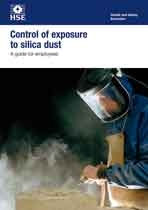
A Guide for Employees Working with Respirable Crystalline Silica (RCS)
LEVCentral Expert Commentary
Respirable Crystalline Silica (RCS) is one of the most significant occupational health hazards encountered across construction, quarrying, foundries, stonemasonry, ceramics, brick manufacture and many engineering industries. Every year, thousands of workers are exposed to silica dust generated during cutting, grinding, drilling, crushing and polishing materials such as concrete, stone, brick and mortar.
HSE INDG463 – Control of Exposure to Silica Dust is written specifically for employees. It explains what silica dust is, where it is found, why it is dangerous and, most importantly, what workers should do to protect themselves. The leaflet complements the employer-focused COSHH guidance by presenting practical advice in straightforward language that operators can readily understand.
The guidance reinforces one of the most important principles in occupational hygiene:
Silica dust is invisible when it is most dangerous.
The respirable fraction consists of particles small enough to penetrate deep into the lungs where they may remain permanently. Because workers cannot see these particles, exposure can easily be underestimated unless suitable engineering controls are used.
For LEV professionals, the leaflet is valuable because it helps explain to employees why Local Exhaust Ventilation (LEV), water suppression and good working practices are essential, rather than simply being additional safety requirements.
View HSE Guide
Key Learning Points
The leaflet explains:
- What Respirable Crystalline Silica (RCS) is.
- Industries and activities where silica dust is generated.
- Why respirable silica dust is hazardous.
- The health effects of long-term exposure, including:
- Silicosis.
- Chronic Obstructive Pulmonary Disease (COPD).
- Lung cancer.
- Why dust should be controlled at source.
- The importance of Local Exhaust Ventilation (LEV).
- Using water suppression to reduce dust generation.
- Correct use of Respiratory Protective Equipment (RPE).
- The importance of health surveillance.
- What employees should do if they believe controls are not working properly.
- Reporting symptoms promptly and cooperating with occupational health programmes.
Source Document Information
Organisation: Health and Safety Executive (HSE)
Document: INDG463 – Control of Exposure to Silica Dust
Current Edition: Updated 2024
Document Type: HSE Information Leaflet (Employee Guide)
Primary Topics: Respirable Crystalline Silica, Occupational Lung Disease, LEV, COSHH, Construction Dust, Employee Awareness.
Audience: Employees, Construction Workers, Stonemasons, Quarry Workers, Foundry Workers, Ceramic Workers, Brick Manufacturers, Supervisors and Health & Safety Representatives.
LEVCentral Perspective
INDG463 is the employee companion to many of HSE’s more technical silica guidance documents.
Rather than discussing regulations or engineering calculations, it focuses on helping workers understand why dust controls matter. This is important because effective LEV depends not only on good engineering but also on operator behaviour. Workers who appreciate the health risks are far more likely to use extraction correctly, report defects and avoid unsafe practices such as dry sweeping or working outside the capture zone.
The leaflet also reinforces another important occupational hygiene principle:
Silica-related diseases are entirely preventable.
Unlike accidental injuries, diseases such as silicosis develop gradually over many years. Good engineering controls, routine maintenance, effective LEV, water suppression and suitable work methods can dramatically reduce exposure throughout a worker’s career.
From an LEVCentral perspective, the leaflet is particularly useful for toolbox talks, induction training and refresher sessions because it explains the subject in language that employees can easily relate to while remaining technically accurate.
Further Resources
HSE has produced an extensive range of guidance covering the control of respirable crystalline silica. Particularly useful companion resources include:
| HSE Publication | Description |
|---|---|
| HSG201 – Controlling Exposure to Stone Dust | Comprehensive guidance on controlling silica exposure in stone working. |
| INDG461 – Using Cut-off Saws: A Guide to Protecting Your Lungs | Practical guidance on controlling silica dust during cut-off saw operations. |
| EH40 – Workplace Exposure Limits | Current Workplace Exposure Limit for respirable crystalline silica. |
| G404 – Health Surveillance for Those Exposed to Respirable Crystalline Silica | Guidance on health surveillance programmes. |
| INDG479 – Guidance on RPE Fit Testing | Ensuring respirators provide effective protection. |
| HSE Silica COSHH Essentials Series | Industry-specific silica guidance including the Construction, Brick & Tile, Ceramics, Foundry, Manufacturing, Quarry and Stonemasonry series. |
Recommended Learning
- M200 Basic Principles in Occupational Hygiene
- M501 Measurement of Hazardous Substances
- M505 Control of Hazardous Substances
- M507 Health Effects of Hazardous Substances
- P304 Fundamentals of CoSHH Risk Assessment & Control
- P603 CoSHH PPE
- P600 Methods for Testing Performance of LEV
- P601 LEV Thorough Examination & Testing
- P602 LEV Basic Design Principles
- P604 LEV Commissioning & Performance Evaluation
Thought Leadership
INDG463 demonstrates that effective occupational hygiene depends on informed employees as well as competent engineering.
Even the best-designed LEV system cannot protect workers if extraction is switched off, capture hoods are moved away from the source or unsafe work practices generate unnecessary dust. By helping employees understand the health consequences of silica exposure and the reasons behind engineering controls, the leaflet encourages the behaviours that make those controls successful.
From a LEVCentral perspective, this publication reinforces a simple but powerful message: silica-related disease is preventable. The combination of good process design, effective Local Exhaust Ventilation, water suppression, competent supervision, routine maintenance and informed workers provides the strongest defence against one of the UK’s most serious occupational health hazards.
Every employee who works with silica-containing materials should read this leaflet, and every employer should ensure its messages become part of everyday working practice.

