IChemE – Dust Explosions in The Process Industries (3rd Ed)
The Definitive International Reference on Combustible Dust Explosion Science and Engineering
LEVCentral Expert Commentary
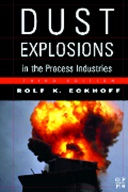
If there is one textbook that has shaped modern understanding of combustible dust explosions, it is undoubtedly Dust Explosions in the Process Industries by Professor Rolf K. Eckhoff.
First published in 1991 and substantially expanded in its third edition (2003), this book is widely regarded as the definitive technical reference on the identification, assessment and control of combustible dust hazards. For over three decades it has been the standard reference consulted by researchers, process engineers, explosion protection specialists and safety professionals throughout the world.
Unlike many publications that focus primarily on legislation or design standards, Eckhoff explains the fundamental science behind dust explosions. He examines how combustible dust clouds are formed, how ignition occurs, how flames propagate, how explosions develop, and how engineering controls such as explosion venting, suppression and isolation can be used to prevent catastrophic consequences. The result is a book that combines rigorous scientific analysis with practical engineering guidance.
For LEV professionals, the book provides an invaluable insight into what happens after combustible dust has been captured. It explains why dust collectors, cyclones, silos, filters and conveying systems require careful consideration from an explosion protection perspective, making it an ideal companion to HSG103 and DSEAR guidance.
Obtain the Book
Key Learning Points
The book covers:
- Fundamentals of combustible dust explosions.
- Historical explosion case studies.
- Formation of explosible dust clouds.
- Re-entrainment of settled dust.
- Flame propagation in dust clouds.
- Dust ignition mechanisms.
- Minimum ignition energy.
- Minimum explosible concentration.
- Dust explosibility testing.
- Explosion vent sizing.
- Explosion suppression systems.
- Explosion isolation.
- Explosion pressure development.
- Laboratory testing methods.
- Ignitability and explosibility data.
- Electrical equipment for combustible dust atmospheres.
- Research developments in dust explosion science.
- Engineering approaches to explosion prevention and mitigation.
Source Information
Author: Professor Rolf K. Eckhoff
Title: Dust Explosions in the Process Industries – Identification, Assessment and Control of Dust Hazards
Edition: Third Edition
Publisher: Elsevier / Gulf Professional Publishing
Publication Year: 2003
Length: Approximately 719 pages
Document Type: Engineering Reference Book
Primary Topics: Combustible Dust, Dust Explosions, Explosion Science, Explosion Venting, Explosion Suppression, Explosion Isolation, Process Safety, DSEAR, Industrial Ventilation.
LEVCentral Perspective
This is not an introductory book.
Unlike HSG103, which explains practical precautions, Eckhoff’s work explores why those precautions are necessary. It develops the scientific understanding behind combustible dust behaviour and explains the physics governing ignition, flame propagation, pressure development and explosion dynamics.
For many LEV engineers, this book represents the point at which combustible dust moves from being a regulatory subject to an engineering discipline.
One of its greatest strengths is the treatment of secondary dust explosions. Many of the world’s worst industrial disasters have not resulted from the initial explosion inside a piece of plant, but from dust deposits throughout the building being disturbed and ignited. The book explains this phenomenon in detail and reinforces the importance of good housekeeping alongside effective LEV and explosion protection.
Another particularly valuable feature is the extensive discussion of laboratory explosibility testing. Understanding properties such as K<sub>st</sub>, P<sub>max</sub>, minimum ignition energy and minimum explosible concentration is essential for anyone involved in designing explosion protection systems.
Although standards have continued to evolve since publication, the underlying scientific principles remain highly relevant and continue to underpin modern DSEAR assessments and explosion protection design.
Further Resources
- HSG103 – Safe Handling of Combustible Dusts: Precautions Against Explosions
- Dust Explosion Prevention and Protection – A Practical Guide (John Barton)
- SHAPA – Sizing of Explosion Relief Vents (Updated 2022)
- SHAPA – Dust Testing for DSEAR & ATEX Compliance
- Dangerous Substances and Explosive Atmospheres Regulations (DSEAR) Approved Code of Practice (L138)
- BS EN 14491 – Dust Explosion Venting Protective Systems
- BS EN 14797 – Explosion Venting Devices
- NFPA 68 – Standard on Explosion Protection by Deflagration Venting
- NFPA 69 – Standard on Explosion Prevention Systems
Recommended Learning
- OXY103 Masterclass DSEAR & ATEX for LEV Specialists
- M505 Control of Hazardous Substances
- P600 Methods for Testing Performance of LEV
- P601 LEV Thorough Examination & Testing
- P602 LEV Basic Design Principles
- P604 LEV Commissioning & Performance Evaluation
Thought Leadership
Every LEV engineer understands that the purpose of a dust extraction system is to remove hazardous airborne contaminants from the workplace. Eckhoff reminds us that capturing combustible dust is only part of the engineering challenge.
Once dust has entered a filter, cyclone, silo or conveying system, the emphasis shifts from occupational hygiene to process safety. At that point, engineers must understand explosion physics, ignition sources, flame propagation and pressure development just as thoroughly as they understand airflow and pressure loss.
Few authors explain these relationships as clearly as Professor Eckhoff.
From a LEVCentral perspective, this book deserves its reputation as the international benchmark for combustible dust explosion engineering. Whilst it is more technical than HSG103 or most practical guidance documents, it provides the scientific foundation upon which much of today’s explosion protection practice has been built.
For anyone wishing to move beyond compliance and truly understand the behaviour of combustible dusts, it remains one of the finest engineering references ever written on the subject.

