HSE SR14 Vehicle Exhaust Fumes (Warehouses, Garages etc)
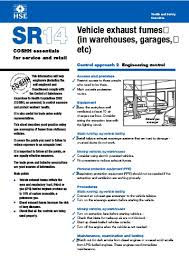
Controlling Exposure to Engine Exhaust Emissions Using Effective Ventilation and Exhaust Extraction
LEVCentral Expert Commentary
Vehicle exhaust emissions have long been recognised as a significant occupational health hazard. Workers in garages, MOT stations, vehicle workshops, warehouses, loading bays, distribution centres and similar workplaces may be exposed to petrol, diesel and LPG engine exhausts during routine vehicle movements or while engines are left running indoors.
HSE guidance SR14 – Vehicle Exhaust Fumes (in Warehouses, Garages, etc.) forms part of the COSHH Essentials Service & Retail (SR) Series and provides practical advice on controlling exposure to engine exhaust emissions. The guidance concentrates on two common situations:
- Stationary vehicles, such as those undergoing servicing, repair, MOT testing or engine diagnostics.
- Moving vehicles, such as fork-lift trucks and delivery vehicles operating inside warehouses or industrial buildings.
For LEV professionals, SR14 is particularly important because it distinguishes between Local Exhaust Ventilation (LEV) and general ventilation, demonstrating that each has a different purpose.
For stationary vehicles, the preferred engineering control is tailpipe exhaust extraction (gas scavenging) that captures exhaust gases directly from the source before they enter the workplace atmosphere. Where vehicles are moving around buildings, the guidance recommends good general ventilation together with measures to minimise exhaust emissions and engine running time.
Although this guidance predates the IARC classification of diesel engine exhaust as a Group 1 human carcinogen, its engineering principles remain entirely valid and continue to represent good practice.
View HSE Guide
Key Learning Points
The guidance explains:
- The health hazards associated with petrol, diesel and LPG engine exhaust emissions.
- The differences between controlling emissions from stationary and moving vehicles.
- The use of tailpipe exhaust extraction systems for vehicle servicing and testing.
- The importance of providing adequate general ventilation within garages and warehouses.
- Why vehicle engines should not be left idling unnecessarily.
- The need to maintain vehicle engines to minimise emissions.
- Inspection and maintenance of exhaust extraction systems.
- Thorough Examination and Testing of LEV where local exhaust systems are installed.
- Employee training and supervision.
- Routine checks to ensure extraction systems continue to operate effectively.
Source Document Information
Organisation: Health and Safety Executive (HSE)
Document: SR14 – Vehicle Exhaust Fumes (in Warehouses, Garages, etc.)
Document Type: COSHH Essentials Guidance Sheet
Primary Topics: Vehicle Exhaust Emissions, Diesel Exhaust, Tailpipe Extraction, LEV, General Ventilation, COSHH
Audience: Garage Operators, MOT Stations, Vehicle Workshops, Warehouse Managers, LEV Designers, Occupational Hygienists, Health & Safety Professionals and Duty Holders.
LEVCentral Perspective
SR14 remains an excellent example of selecting the right engineering control for the right task.
For a vehicle undergoing servicing or emissions testing, tailpipe extraction is almost always the preferred solution because it captures pollutants directly at source. Attempting to dilute exhaust gases after they have entered the workplace is far less effective.
In contrast, where vehicles are continually moving around a warehouse, direct source capture is often impractical. Here, HSE recommends a combination of good building ventilation, minimising engine running time, maintaining vehicles in good condition and, where practicable, replacing internal combustion vehicles with electric alternatives.
The guidance also highlights another important point for LEV practitioners. Tailpipe extraction systems are Local Exhaust Ventilation systems and, as such, they require proper design, commissioning, maintenance and periodic Thorough Examination and Testing to ensure they continue to protect workers effectively.
Further Resources
- HSG258 – Controlling Airborne Contaminants at Work
- HSG187 – Control of Diesel Engine Exhaust Emissions in the Workplace
- COSHH Approved Code of Practice (L5)
- EH40 – Workplace Exposure Limits
Recommended Learning
- M200 Basic Principles in Occupational Hygiene
- M501 Measurement of Hazardous Substances
- M505 Control of Hazardous Substances
- M507 Health Effects of Hazardous Substances
- P304 Fundamentals of CoSHH Risk Assessment & Control
- P603 CoSHH PPE
- P600 Methods for Testing Performance of LEV
- P601 LEV Thorough Examination & Testing
- P602 LEV Basic Design Principles
- P604 LEV Commissioning & Performance Evaluation
Thought Leadership
Vehicle exhaust extraction systems are sometimes overlooked because they appear relatively simple when compared with industrial LEV installations. In reality, they represent one of the clearest demonstrations of the source capture principle.
Connecting an exhaust extraction hose directly to a vehicle tailpipe prevents contaminants from entering the workplace in the first place. It is a textbook example of controlling exposure at source rather than attempting to deal with contaminants after they have dispersed.
Although awareness of diesel exhaust risks has increased significantly since SR14 was first published, the engineering philosophy remains unchanged.
Good LEV design begins by understanding where contaminants are generated and capturing them as close to the source as reasonably practicable. Tailpipe extraction systems achieve exactly that and continue to represent one of the simplest and most effective forms of Local Exhaust Ventilation in everyday use.

