HSE Explanation of Special Lighting Set-up to Show Invisible Paint Mist
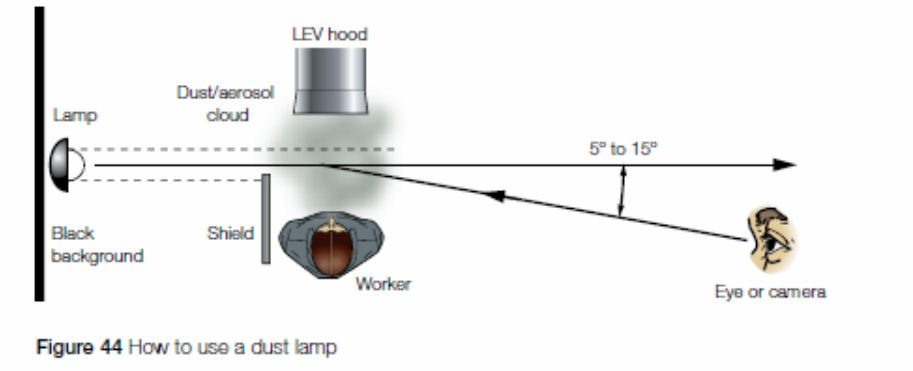
Using Tyndall Lighting to Visualise Airborne Contaminants
This HSE presentation explains how special lighting arrangements, commonly known as Tyndall lighting, can be used to make otherwise invisible airborne contaminants visible during LEV assessments and occupational hygiene investigations.
The technique uses a powerful light source directed across a darkened workspace. Airborne particles scatter the light, allowing paint mist, welding fume, dust and other contaminants to be observed directly. This enables assessors to visualise contaminant movement, identify leakage points and evaluate the effectiveness of extraction systems.
Tyndall lighting is particularly valuable when assessing:
- Spray painting operations
- Paint booths
- Welding fume control
- Woodworking dust extraction
- Powder handling processes
- Process enclosure performance
- Hood capture effectiveness
- Airflow patterns and leakage
The guidance demonstrates how appropriate lighting can reveal contaminant behaviour that may not be apparent through airflow measurements alone.
This resource is relevant to:
- Occupational Hygienists
- P601 TExT Engineers
- LEV Consultants
- LEV Designers
- Commissioning Engineers
- Health & Safety Professionals
- Spray Booth Inspectors
- Process Engineers
- Duty Holders
Source Document
View the HSE guidance here:
Source: Health and Safety Executive (HSE)
Document Type: Technical Presentation
Status: Current Guidance
Last reviewed by LEVCentral: June 2026
LEVCentral Expert Commentary
One of the most common weaknesses in LEV assessment is an over-reliance on numerical measurements alone.
Airflow readings, static pressure measurements and face velocities all provide valuable information, but they do not necessarily show what is actually happening to contaminants once they are released into the workplace atmosphere.
This is where Tyndall lighting becomes extremely powerful.
By illuminating airborne particles, the assessor can directly observe contaminant behaviour in real time. Paint mist that appears to be adequately controlled may be seen escaping around booth openings. Dust clouds may reveal unexpected airflow patterns. Welding fume may demonstrate poor capture despite apparently acceptable airflow measurements.
For P601 engineers, Tyndall assessments can provide supporting evidence when evaluating:
- Hood effectiveness
- Containment performance
- Booth leakage
- Operator positioning
- Airflow direction
- Cross-draught interference
- Process changes
The technique is particularly useful when investigating customer complaints where conventional testing indicates satisfactory performance but users continue to experience exposure problems.
From a LEVCentral perspective, Tyndall lighting reinforces an important principle:
Effective LEV assessment is about understanding contaminant behaviour, not simply collecting airflow data.
The most defensible examinations combine quantitative measurements with qualitative observations. When both methods support the same conclusion, confidence in the assessment is significantly strengthened.
For this reason, Tyndall lighting remains one of the most valuable practical tools available to occupational hygienists and LEV engineers.
Key Learning Points
Airflow Measurements Do Not Tell the Whole Story
Numerical measurements should be supported by observations of actual contaminant movement wherever possible.
Invisible Contaminants Can Be Visualised
Tyndall lighting allows airborne particles to become visible by scattering light through the contaminant cloud.
Particularly Useful for Spray Painting
The technique is widely used when assessing paint booths and spray application processes where fine mist may otherwise be difficult to observe.
Supports Defensible LEV Assessments
Visual evidence can strengthen commissioning reports, TExT reports and occupational hygiene investigations.
Further Resources
- HSE MDHS 82/2 The Dust Lamp
- HSG258 – Controlling Airborne Contaminants at Work
- Purchase Dust Lamps here:-
Recommended Learning
- P600 Methods for Testing Effectiveness of LEV
- P601 Thorough Examination and Testing of LEV Systems
- P602 LEV Design Principles
- OXY102 Completing LEV TExT Reports
- M200 Basic Principles of Occupational Hygiene
- M505 Control of Hazardous Substances
LEVCentral Observation
Tyndall lighting is often regarded as a specialist occupational hygiene technique, yet it can provide some of the most compelling evidence available during an LEV assessment.
Seeing contaminants escape from a process frequently has greater impact on duty holders than any airflow measurement or technical report.
When used alongside conventional testing methods, it can significantly improve understanding of exposure risks and help organisations make better-informed decisions regarding control measures.

