Fletcher’s Equations for Captor Hoods – Free Excel Spreadsheet and Mobile App
Fletcher’s Equations for Captor Hoods – Free Excel Spreadsheet and Mobile App
Fletcher’s Equations are the methodology recommended by HSE for calculating captor hood performance and effective captor distances. They are widely used by LEV designers, commissioning engineers and TExT engineers when assessing captor hood effectiveness and determining required hood entry velocities.
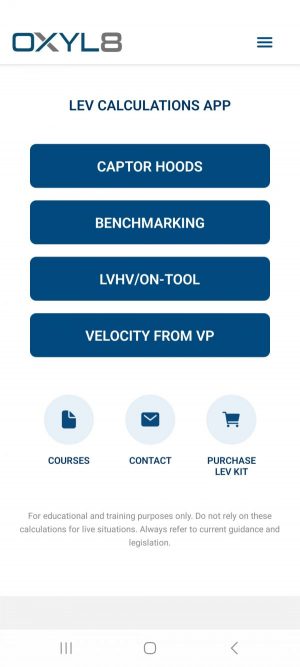
The equations can be mathematically challenging to solve manually. To simplify the process, OXYL8 has developed both a free Excel spreadsheet and a free mobile application for Apple and Android devices.
The tools allow users to:
• Calculate required hood entry velocity for a specified captor velocity and working distance.
• Determine effective captor distance from measured face velocity.
• Assess captor hood performance during TExT examinations.
• Support LEV system design and commissioning activities.
• Verify compliance with accepted LEV design methodologies.
The Fletcher calculations contained within this spreadsheet are also available within the free OXYL8 LEV Calculations App for Apple and Android devices.
The app includes Fletcher calculations, captor hood benchmarking tools, LVHV calculations and other practical LEV engineering aids used extensively throughout the LEV industry.
Source Document
Download the OXYL8 Spreadsheet here:
Source: OXYL8
Document Type: Fletcher Spreadsheet
Status: 2022
Last reviewed by LEVCentral: June 2026
LEVCentral Expert Commentary
One of the most common errors encountered during LEV design and testing is the assumption that a satisfactory face velocity automatically delivers satisfactory contaminant control.
Captor hoods operate by creating a velocity field that extends away from the hood opening. The critical design question is therefore not simply the velocity at the hood face, but the velocity that exists where the contaminant is actually generated.
Fletcher’s Equations provide a practical means of predicting this relationship. They allow engineers to estimate the hood entry velocity required to achieve a target captor velocity at a specified distance from the hood.
For P602 designers, the equations assist with determining design airflow requirements before installation. For P601 engineers they provide an objective method of assessing whether an existing captor hood is capable of providing adequate contaminant capture at the actual point of release.
The free Excel spreadsheet and mobile app remove much of the mathematical complexity and make Fletcher calculations accessible during surveys, commissioning activities and TExT examinations.
Importantly, these tools should not be viewed as a substitute for competent engineering judgement. Hood positioning, process movement, cross-draughts, thermal effects and operator behaviour remain critical factors when determining whether a captor hood will achieve effective contaminant control.
Further Resources
- Fletchers Nomogram with notes
- Video – Captor Hoods
- HSG258 – Controlling Airborne Contaminants at Work
- G406 – New and Existing Engineering Control Systems
Recommended Learning
- P602 LEV Design Principles
- P601 Thorough Examination and Testing
- P600 Methods for Testing Effectiveness of LEV
- P604 Performance Evaluation and Management

