Fan Laws and System Curves
Why Every LEV Designer and Commissioning Engineer Should Understand Fan Performance Relationships
LEVCentral Expert Commentary
Few engineering principles are more useful to LEV designers, commissioning engineers and ventilation practitioners than the Fan Laws. Despite their apparent simplicity, these relationships underpin many of the decisions made when designing, modifying, troubleshooting and commissioning ventilation systems.
This article provides an accessible explanation of the three basic Fan Laws and demonstrates how changes in fan speed influence airflow, pressure and power consumption. Understanding these relationships is essential when evaluating system modifications, balancing installations, selecting replacement equipment or investigating performance issues.
For those involved in LEV design, the Fan Laws help explain why relatively small changes in fan speed can have significant effects on system performance. Increasing fan speed may increase airflow, but it also increases pressure requirements and can dramatically increase energy consumption. Similarly, reducing fan speed can provide substantial energy savings whilst still maintaining adequate system performance.
The article is particularly useful because it bridges the gap between theoretical engineering relationships and practical ventilation applications. Whether using variable speed drives, adjusting pulley arrangements or assessing replacement fans, the Fan Laws provide a valuable framework for predicting system behaviour.
For commissioning engineers, these principles are equally important when interpreting performance data. Understanding how airflow, pressure and power interact can help identify whether measured results are reasonable and whether system modifications are likely to achieve the desired outcome.
Perhaps most importantly, the Fan Laws remind us that ventilation systems are dynamic. Changes made to one aspect of the system frequently influence several others, reinforcing the need for a holistic approach to design and performance verification.
View Original Article
Key Learning Points
- Fan performance is governed by a series of well-established engineering relationships known as the Fan Laws.
- Airflow is directly proportional to fan rotational speed.
- Static pressure varies approximately with the square of fan speed.
- Power consumption varies approximately with the cube of fan speed.
- Small increases in fan speed can result in large increases in energy consumption.
- Variable speed control can provide significant operational flexibility and energy savings.
- Fan Laws are useful when evaluating system modifications and performance changes.
- Understanding fan behaviour helps improve troubleshooting and commissioning activities.
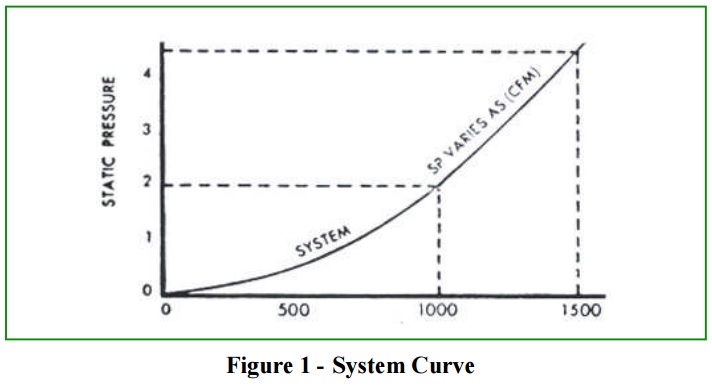
- Fan performance should always be considered alongside system resistance characteristics.
- Changes to airflow requirements may have significant implications for motor loading and energy use.
Source Document Information
Organisation: Eldridge USA
Document: Understanding and Applying the Three Basic Fan Laws
Document Type: Technical Engineering Article
Primary Topics: Fan Laws, Fan Performance, Airflow, Static Pressure, Energy Consumption, Ventilation Engineering
Audience: LEV Designers, Ventilation Engineers, Commissioning Engineers, Occupational Hygienists, Facilities Engineers and Technical Practitioners
Further Resources
- CIBSE Guide B2 – Ventilation and Ductwork
- Bernoulli’s Principle and the Venturi Effect
- BSRIA BG 49/2024 – Commissioning Air Systems
- HSG258 – Controlling Airborne Contaminants at Work
- Woods Fan Guide
Recommended Learning
- OXY103 Masterclass DSEAR/ATEX for LEV Engineers
- M505 Control of Hazardous Substances
- P600 Methods for Testing Performance of LEV
- P601 LEV Thorough Examination & Testing
- P602 LEV Basic Principles of Design
- P604 LEV Commissioning & Performance Evaluation
Thought Leadership
The Fan Laws are often introduced as simple equations during ventilation training courses, but their real value emerges when applied to practical engineering problems. Many common ventilation issues, from poor system performance to unexpectedly high energy costs, can be better understood through these relationships.
For LEV professionals, the third Fan Law is perhaps the most important and the most frequently overlooked. Whilst increasing fan speed may appear to be an easy solution to performance concerns, the associated increase in power demand can be substantial. In some cases, improving hood design, reducing system resistance or rebalancing airflow may provide a more effective and energy-efficient solution than simply increasing fan duty.
As the industry increasingly focuses on energy efficiency, carbon reduction and sustainable ventilation design, understanding the Fan Laws becomes more important than ever.
They remain one of the most powerful tools available for predicting how ventilation systems will respond to change and for ensuring that engineering decisions are both technically sound and economically justified.

