Fan Handbook – Selection, Application & Design
One of the Most Comprehensive Engineering References on Industrial Fans
LEVCentral Expert Commentary
Every Local Exhaust Ventilation (LEV) system ultimately depends upon one critical component—the fan. It is the fan that creates the pressure difference needed to move contaminated air through the hood, ductwork, air cleaner and discharge stack. Despite this, relatively few LEV engineers have a detailed understanding of fan design and performance.
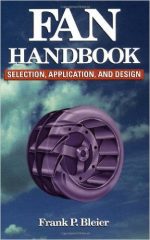
Fan Handbook – Selection, Application, and Design, by Frank P. Bleier, is widely regarded as one of the most comprehensive textbooks ever published on industrial fan technology. First published by McGraw-Hill in 1997, the 640-page reference covers virtually every aspect of fan engineering, from aerodynamic theory through to selection, testing, installation, troubleshooting and maintenance.
Although not written specifically for LEV engineers, the book contains an enormous amount of material directly applicable to LEV system design. Topics such as fan laws, system resistance, pressure losses, fan testing, AMCA standards and duct system design underpin many of the calculations performed during LEV design and commissioning.
If Bill Woods’ Guide to Fan Engineering is regarded as the classic British text on industrial fans, Bleier’s Fan Handbook is arguably its American counterpart—more modern, broader in scope and heavily supported by engineering data, equations, graphs and worked examples.
Obtain the Book
This remains a standard engineering reference and is available new and second-hand from a number of suppliers.
Older second-hand copies can often be found at very reasonable prices through specialist engineering booksellers, including on Amazon Marketplace and eBay.
Key Learning Points
The handbook covers:
- Fundamentals of airflow and fluid mechanics.
- Airfoil design.
- Axial-flow fans/Centrifugal fans/Mixed-flow fans.
- Cross-flow blowers/Regenerative blowers.
- Roof ventilators.
- Fan laws.
- Fan selection.
- System resistance/Pressure losses.
- Fan performance curves.
- Fan testing to AMCA standards.
- Duct systems.
- Ventilation requirements.
- Fan drives and control methods.
- Energy efficiency.
- Noise and vibration.
- Mechanical design.
- Installation and commissioning.
- Maintenance and troubleshooting.
- Performance prediction.
- Air curtains/Ceiling fans/Vacuum systems.
- Symbols, units and engineering conversion factors.
Source Information
Author: Frank P. Bleier
Title: Fan Handbook – Selection, Application, and Design
Publisher: McGraw-Hill
First Published: 1997
Length: Approximately 640 pages
Document Type: Engineering Reference Book
Primary Topics: Industrial Fans, Fan Selection, Aerodynamics, Ventilation Engineering, LEV Design, Fan Testing, Duct Systems.
LEVCentral Perspective
Many LEV engineers become highly competent at measuring airflow, calculating duct velocities and carrying out Thorough Examination and Testing without ever developing a detailed understanding of the machine producing that airflow.
This handbook fills that gap.
One of the book’s greatest strengths is that it treats the fan as an engineering component rather than simply another item within the ventilation system. It explains how fan geometry influences performance, how pressure is developed, why efficiency varies between designs and how fans interact with the resistance characteristics of the complete system.
For LEV designers, this knowledge is invaluable. Understanding fan curves and system curves makes it much easier to appreciate why adding another hood, changing filter resistance or modifying ductwork can significantly alter system performance.
The chapters on fan laws, system resistance and performance testing are particularly relevant to anyone involved in LEV commissioning or fault-finding. These subjects underpin many of the measurements taken during commissioning and statutory Thorough Examination and Testing.
Although some standards have evolved since publication, the engineering principles described throughout the book remain just as relevant today.
Further Resources
- Woods Guide to Fan Engineering – A classic British reference on fan technology.
- ACGIH – Industrial Ventilation: A Manual of Recommended Practice for Design – The international benchmark for industrial ventilation design.
- HSG258 – Controlling Airborne Contaminants at Work – HSE guidance on LEV design, commissioning and Thorough Examination & Testing.
- AMCA Standards – International standards covering fan testing and performance.
Recommended Learning
- M505 Control of Hazardous Substances
- P600 Methods for Testing Performance of LEV
- P601 LEV Thorough Examination & Testing
- P602 LEV Basic Design Principles
- P604 LEV Commissioning & Performance Evaluation
Thought Leadership
There is a tendency within LEV to think of the fan as simply the component at the end of the ductwork.
In reality, the fan determines whether the entire system succeeds or fails.
An extraction hood can be beautifully designed, the ductwork carefully sized and the filters correctly selected, but if the fan is unable to overcome the total system resistance, contaminant capture will be compromised. Conversely, an oversized fan can create excessive velocities, unnecessary energy consumption, increased noise and accelerated filter loading.
Books such as Fan Handbook remind us that successful LEV design depends upon understanding the complete ventilation system—not just the hood where contaminants are captured.
For engineers wishing to move beyond routine testing into advanced system design, this remains one of the finest single-volume references available on industrial fan technology.

