Ductulators and Duct Calculation Tools
Handheld, Online and Mobile Calculators for LEV and Ventilation Design
LEVCentral Expert Commentary
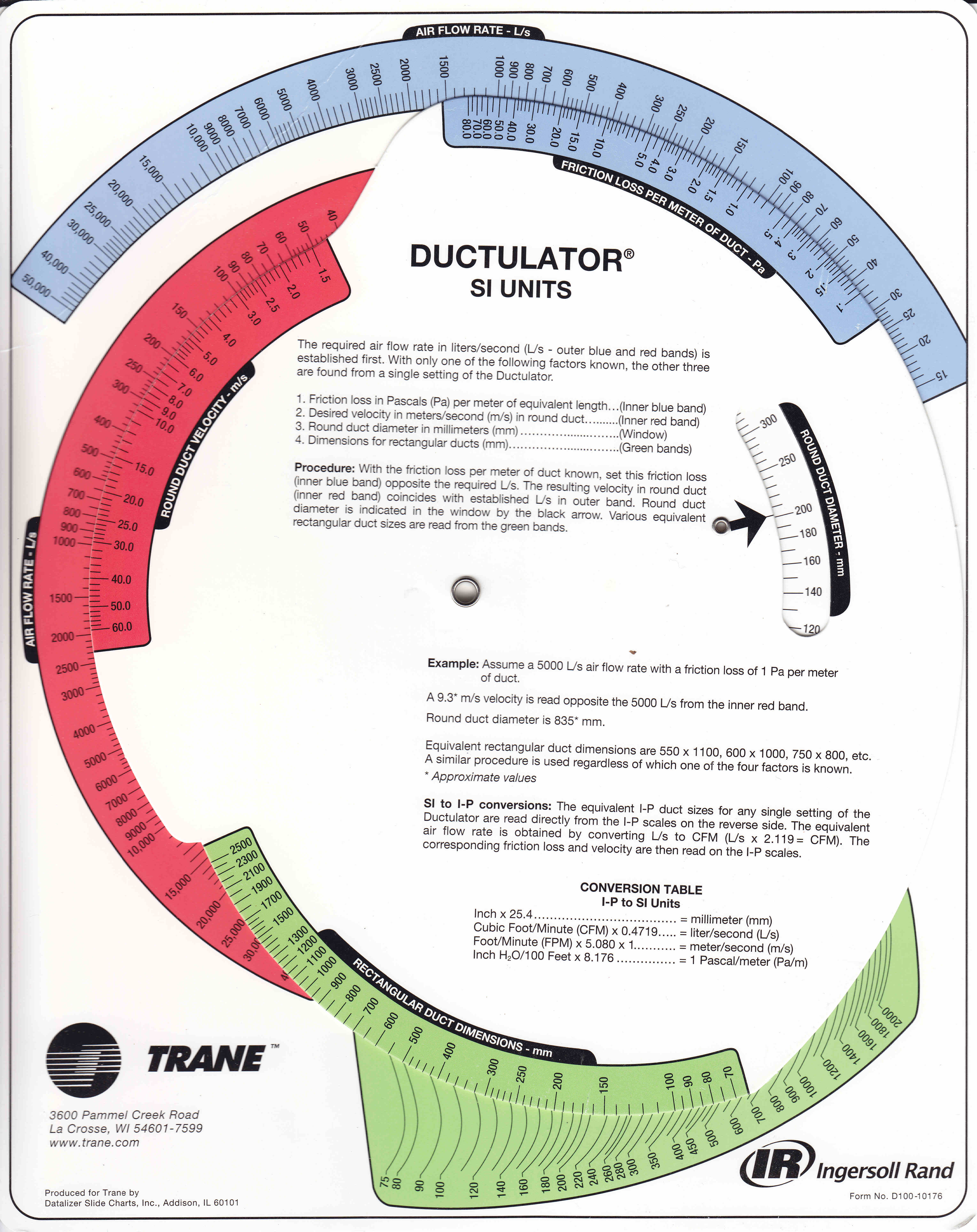
Before smartphones and engineering software became commonplace, almost every ventilation engineer carried a Ductulator—a circular slide-rule calculator used to determine duct diameters, air velocities, pressure losses and flow relationships. Although simple in appearance, these devices remain remarkably effective and continue to be used by many experienced LEV designers.
Today, engineers can choose between traditional rotating-wheel ductulators, smartphone applications and online calculators. Most perform the same basic calculations, allowing rapid estimation of duct sizes, air velocities, friction losses and equivalent duct dimensions without resorting to lengthy manual calculations or spreadsheets.
For LEV professionals, these tools are particularly useful during preliminary design, commissioning and fault-finding. Whilst they should never replace engineering judgement or detailed design calculations, they provide a quick method of checking whether proposed duct sizes and air velocities are broadly appropriate.
One important point should always be remembered:
A ductulator performs calculations—it does not design an LEV system.
Correct hood selection, contaminant behaviour, transport velocities, pressure losses through hoods and filters, fan selection and system balancing still require competent engineering knowledge.
Recommended Ductulators
Based upon feedback from LEVCentral users and general availability, the following tools are worth considering:
| Tool | Format | Comments |
|---|---|---|
| Physical Circular Ductulator | Hand-held wheel | Traditional slide-rule calculator. Robust, requires no batteries and remains extremely useful for quick calculations. |
| Duct Calc Elite | Android App | Well-regarded mobile calculator covering duct sizing, velocity, pressure loss and related calculations. |
| HVAC Duct Sizer | Android App | Useful mobile application for duct sizing and airflow calculations. |
| Online Ductulator | Web-based | Convenient browser-based calculator for occasional use without installing software. |
(LEVCentral does not endorse any particular product. Users should satisfy themselves that calculations are suitable for their intended application.)
OXYL8 LEV App
Alongside traditional ductulators and ventilation calculators, the OXYL8 LEV App provides a growing collection of practical engineering tools designed specifically for LEV professionals.
Although it is not intended to replace a ductulator, the app currently includes a number of useful field calculations and reference tools that support LEV design, commissioning and Thorough Examination & Testing. These include airflow conversions, velocity calculations, hood face area calculations, capture velocity estimations, duct sizing assistance, reference tables and other practical engineering aids commonly required during site work.
The OXYL8 App continues to be developed and additional calculation modules are added as new functionality becomes available.
Key Learning Points
Ductulators can be used to estimate:
- Circular duct diameters.
- Rectangular duct equivalents.
- Air velocity.
- Volume flow rate.
- Friction loss.
- Pressure loss per unit length.
- Equivalent duct sizes.
- Velocity pressure relationships.
- Basic duct sizing during preliminary design.
- Rapid checks during commissioning and fault-finding.
Most are intended for initial engineering calculations rather than detailed final design.
Source Information
Resource Type: Engineering Calculation Tools
Primary Topics: Duct Sizing, Airflow Calculations, Pressure Loss, Air Velocity, LEV Design
Audience: LEV Designers, Commissioning Engineers, LEV Test Engineers, Mechanical Engineers, Occupational Hygienists, Students and BOHS Candidates.
LEVCentral Perspective
Every experienced LEV engineer develops an instinct for airflow, but that instinct should always be supported by calculation.
Ductulators remain one of the quickest ways of checking whether proposed duct sizes are likely to achieve suitable transport velocities and whether excessive pressure losses may arise. They are particularly useful during site surveys, commissioning visits and early design discussions where rapid engineering decisions are required.
However, a ductulator should never be mistaken for a complete design tool. It cannot determine whether a hood will achieve adequate contaminant capture, whether transport velocities are appropriate for a particular material, or whether the selected fan will operate at its design duty point.
Those decisions require engineering competence.
Further Resources
- HSG258 – Controlling Airborne Contaminants at Work
- ACGIH – Industrial Ventilation: A Manual of Recommended Practice for Design
Recommended Learning
- M200 Basic Principles in Occupational Hygiene
- M501 Measurement of Hazardous Substances
- M505 Control of Hazardous Substances
- M507 Health Effects of Hazardous Substances
- P304 Fundamentals of CoSHH Risk Assessment & Control
- P603 CoSHH PPE
- P600 Methods for Testing Performance of LEV
- P601 LEV Thorough Examination & Testing
- P602 LEV Basic Design Principles
- P604 LEV Commissioning & Performance Evaluation
Thought Leadership
The continued popularity of the ductulator is a reminder that good engineering does not always require complex software. Understanding the relationship between airflow, velocity, duct size and pressure loss remains one of the fundamental skills of every ventilation engineer.
Modern software undoubtedly provides greater accuracy and can model complete systems, but engineers who understand the principles behind a ductulator are often better equipped to recognise design errors, identify implausible results and make informed decisions on site. In that respect, the humble ductulator remains far more than a nostalgic engineering tool—it is an excellent way of developing intuition about how ventilation systems behave.
For students and engineers entering the LEV profession, learning to use a ductulator provides valuable insight into the relationships that underpin all ventilation system design, whether calculations are performed on a circular slide rule, a smartphone or sophisticated engineering software.

