A Scientific Review of Dust Collection – The Real Dirt on Dust (Third Edition)
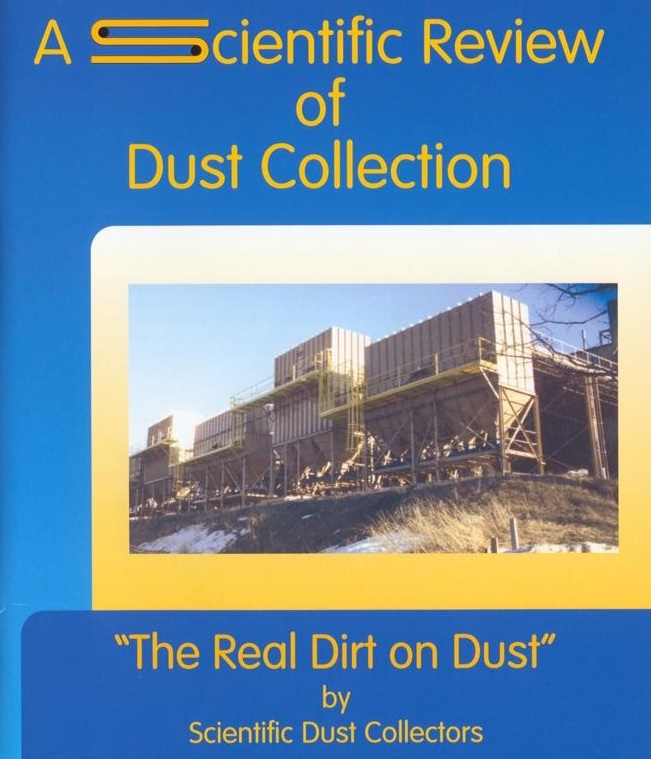
This publication is widely regarded as one of the most comprehensive freely available books dedicated solely to industrial dust collection engineering.
LEVCentral Expert Commentary
Dust collection is far more than selecting a filter or installing a fan. Effective systems require an understanding of contaminant characteristics, airflow, filtration technology, fan performance, explosion protection, maintenance and long-term operational management.
A Scientific Review of Dust Collection – The Real Dirt on Dust is one of the most comprehensive practical guides available on industrial dust collection technology. Produced by Scientific Dust Collectors, the book explains the history, theory and application of virtually every major dust collection technology used in modern industry. The third edition has been expanded to include updated information on cyclone collectors, system design, filter media, explosive dust control, fan engineering and ANSI/ASHRAE Standard 199, the first recognised performance testing standard specifically developed for industrial pulse-cleaned dust collectors.
Unlike many manufacturer’s brochures, this publication takes an educational approach. It explains why different collector technologies perform as they do, discusses their advantages and limitations, and helps engineers understand how to select the most appropriate solution for a particular application.
The book covers virtually every major dust collection technology, including:
- Cyclones and inertial separators
- Wet scrubbers
- Electrostatic precipitators (ESPs)
- Fabric filter baghouses
- Cartridge collectors
- Pleated filter bags
- Filter media
- Fans
- Explosion hazards
- Moisture effects
- Dust collector maintenance
- Troubleshooting
- System design calculations
For LEV designers, commissioning engineers and occupational hygienists, the publication provides an excellent bridge between theoretical ventilation design and practical dust collection engineering.
View Resource
Key Learning Points
The publication provides practical guidance on:
- Principles of industrial dust collection.
- Cyclone separator design and application.
- Wet scrubbers and air washers.
- Electrostatic precipitators.
- Pulse-jet baghouse collectors.
- Cartridge dust collectors.
- Pleated filter technology.
- Filter media selection.
- Fan theory and performance.
- System design and pressure loss.
- Dust explosion hazards and protection.
- Moisture effects on collector performance.
- ANSI/ASHRAE Standard 199.
- Dust collector commissioning.
- Preventative maintenance.
- Troubleshooting common operational problems.
- Engineering reference data and design worksheets.
Source Document Information
Organisation: Scientific Dust Collectors
Document: A Scientific Review of Dust Collection – The Real Dirt on Dust (Third Edition)
Document Type: Technical Reference Book
Primary Topics: Dust Collection, LEV Design, Air Cleaning, Filtration, Fans, Explosion Protection, Maintenance
Audience: LEV Designers, Dust Control Engineers, Commissioning Engineers, Occupational Hygienists, Mechanical Engineers, Maintenance Engineers and Duty Holders.
LEVCentral Perspective
One of the strengths of this publication is that it recognises dust collection as an integrated engineering discipline rather than a collection of individual components.
Many engineers become highly familiar with one particular collector type—perhaps cartridge filters or baghouses—but have limited exposure to alternative technologies. This book broadens that perspective by explaining the strengths, limitations and appropriate applications of the major dust collection systems used throughout industry.
It also reinforces a principle that appears throughout LEVCentral:
Successful LEV systems are designed as complete systems.
The hood, ductwork, fan, air cleaner, explosion protection and discharge arrangements must all work together. Optimising one component while neglecting another rarely produces the best overall performance.
Further Resources
- ACGIH – Industrial Ventilation: A Manual of Recommended Practice for Design
- HSG258 – Controlling Airborne Contaminants at Work
- SHAPA – Dust Hood Selection
- SHAPA – Cartridge Filter Technology
- SHAPA – Dust Testing for DSEAR & ATEX Compliance
Recommended Learning
- M200 Basic Principles in Occupational Hygiene
- M501 Measurement of Hazardous Substances
- M505 Control of Hazardous Substances
- M507 Health Effects of Hazardous Substances
- P304 Fundamentals of CoSHH Risk Assessment & Control
- P603 CoSHH PPE
- P600 Methods for Testing Performance of LEV
- P601 LEV Thorough Examination & Testing
- P602 LEV Basic Design Principles
- P604 LEV Commissioning & Performance Evaluation
Thought Leadership
As industrial processes become more demanding and energy costs continue to rise, dust collection systems can no longer be viewed simply as pollution control equipment. They are integral parts of modern manufacturing processes, influencing worker health, environmental compliance, product quality, energy consumption and operational reliability.
One of the greatest strengths of The Real Dirt on Dust is its systems approach. Rather than treating cyclones, baghouses, cartridge filters and fans as isolated technologies, it demonstrates how each contributes to the overall performance of the dust collection system. This mirrors modern LEV engineering, where success depends not on selecting the “best” collector, but on selecting the right collector for the contaminant, the process and the operational environment.
For anyone seeking to deepen their understanding of industrial dust collection, this publication provides an excellent practical reference that complements HSG258 and the ACGIH Industrial Ventilation Manual, while focusing specifically on the engineering of dust collection systems.

