Testing Walk-In Spray Booths – Smoke Clearance Times
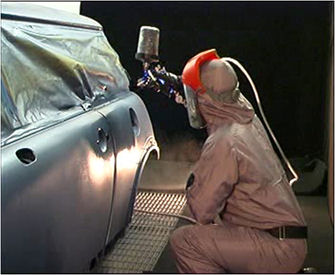
A Practical Guide to Measuring Spray Booth Clearance Times
LEVCentral Expert Commentary
This short but highly informative article, originally published by Diamond Environmental in 2011, explains one of the most important—but often overlooked—aspects of spray booth performance: clearance time testing.
When spraying two-pack isocyanate paints, the visible overspray disappears quickly, but the hazardous airborne paint mist may remain suspended within the booth for some time. Entering the booth too early, or removing respiratory protective equipment before the contaminated air has been fully cleared, can expose workers to isocyanates—one of the leading causes of occupational asthma in the UK.
The article explains why the Health and Safety Executive recommends using smoke testing to determine booth clearance times. Rather than attempting repeated air sampling for isocyanates, which is technically difficult and expensive, smoke is introduced into the booth and the time taken for complete clearance is measured. This provides a practical method of determining how long operators should wait before entering the booth without respiratory protection.
For LEV professionals, the article provides an excellent introduction to an important aspect of spray booth commissioning and Thorough Examination & Testing (TExT). It also reinforces the principle that a spray booth should be assessed not only by airflow measurements, but by demonstrating that contaminants are effectively removed from the working enclosure.
View Original Article
Key Learning Points
The article explains:
- Why spray booth clearance times are important.
- The health risks associated with airborne isocyanate paint mist.
- Why direct air sampling is often impractical for determining clearance time.
- How smoke testing provides a practical alternative.
- The importance of measuring complete smoke clearance.
- Why booth clearance times should be displayed at the booth entrance.
- The HSE’s preference for automatic clearance-time indicators on new spray booths.
- Why clearance time testing should form part of routine LEV Thorough Examination and Testing.
- The need to reassess clearance times as extraction performance changes over time.
Source Document Information
Organisation: Diamond Environmental
Article: Testing Walk-in Spray Booths
Publication Date: February 2011
Document Type: Technical Blog Article
Primary Topics: Spray Booths, Smoke Clearance Testing, Isocyanates, LEV Testing, Commissioning, TExT
Audience: LEV Engineers, Spray Booth Inspectors, Bodyshop Managers, Occupational Hygienists, Health & Safety Professionals and Duty Holders.
LEVCentral Perspective
Although written more than a decade ago, this remains one of the clearest explanations of why clearance time testing matters.
One point deserves particular emphasis. The article notes that clearance times should ideally be established during commissioning, when the booth is first installed, and then rechecked during subsequent statutory Thorough Examination and Testing. This aligns closely with LEVCentral’s philosophy that commissioning should establish the performance baseline against which future deterioration can be measured.
The article also highlights something that is often forgotten during LEV testing: the user needs practical information. Knowing that a booth achieves a particular airflow rate is useful to the engineer, but knowing that operators must wait, for example, 90 seconds before removing RPE is far more useful to the person carrying out the work.
This emphasis on translating engineering measurements into practical operational guidance is one of the strengths of the article.
Further Resources
- HSE – Controlling Isocyanate Exposure in Spray Booths and Spray Rooms
- HSG258 – Controlling Airborne Contaminants at Work
- INDG388 – Safety in Isocyanate Paint Spraying
Recommended Learning
- M200 Basic Principles in Occupational Hygiene
- M501 Measurement of Hazardous Substances
- M505 Control of Hazardous Substances
- M507 Health Effects of Hazardous Substances
- P304 Fundamentals of CoSHH Risk Assessment & Control
- P603 CoSHH PPE
- P600 Methods for Testing Performance of LEV
- P601 LEV Thorough Examination & Testing
- P602 LEV Basic Design Principles
- P604 LEV Commissioning & Performance Evaluation
Thought Leadership
Clearance time testing demonstrates an important truth about LEV performance: airflow measurements alone do not tell the whole story.
Ultimately, the purpose of a spray booth is not simply to move air—it is to remove hazardous contaminants from the worker’s environment. Smoke clearance testing provides a simple visual demonstration of whether the booth is achieving that objective and converts engineering performance into meaningful operational guidance for users.
From a broader LEVCentral perspective, clearance time testing is an excellent example of performance verification rather than performance assumption. Rather than assuming the booth is safe because the fan is running, the engineer demonstrates—through practical testing—how long contaminants remain within the enclosure.
This is precisely the type of evidence-based assurance that underpins modern LEV commissioning and ongoing system verification.

