LEV Basic Maths Revision Guide
Document Type: Learning Resource / Pre-Course Revision Guide
Produced By: OXYL8 Ltd
Topic Areas:
- LEV Training
- P601 Preparation
- LEV Calculations
- Duct Velocity
- Flowrate Calculations
- Pitot Tube Measurements
- Commissioning Fundamentals
Source Document
Last reviewed by LEVCentral: June 2026
Source Video
LEVCentral Expert Commentary
One of the most common challenges faced by delegates attending LEV training courses is not a lack of technical understanding of LEV systems, but a loss of confidence in basic mathematics.
Many engineers have not needed to perform manual calculations for several years. Modern manometers, airflow instruments and LEV software often perform calculations automatically, meaning the underlying mathematics can easily be forgotten.
Unfortunately, professional LEV work still requires engineers to understand:
- Duct area calculations
- Velocity pressure calculations
- Velocity conversions
- Flowrate calculations
- Unit conversions
- System balancing calculations
The BOHS P601 examination requires candidates to demonstrate an understanding of these principles and to apply them manually during assessments and practical exercises.
This revision guide has been developed specifically to refresh the maths skills most commonly used during LEV testing, commissioning and examination activities.
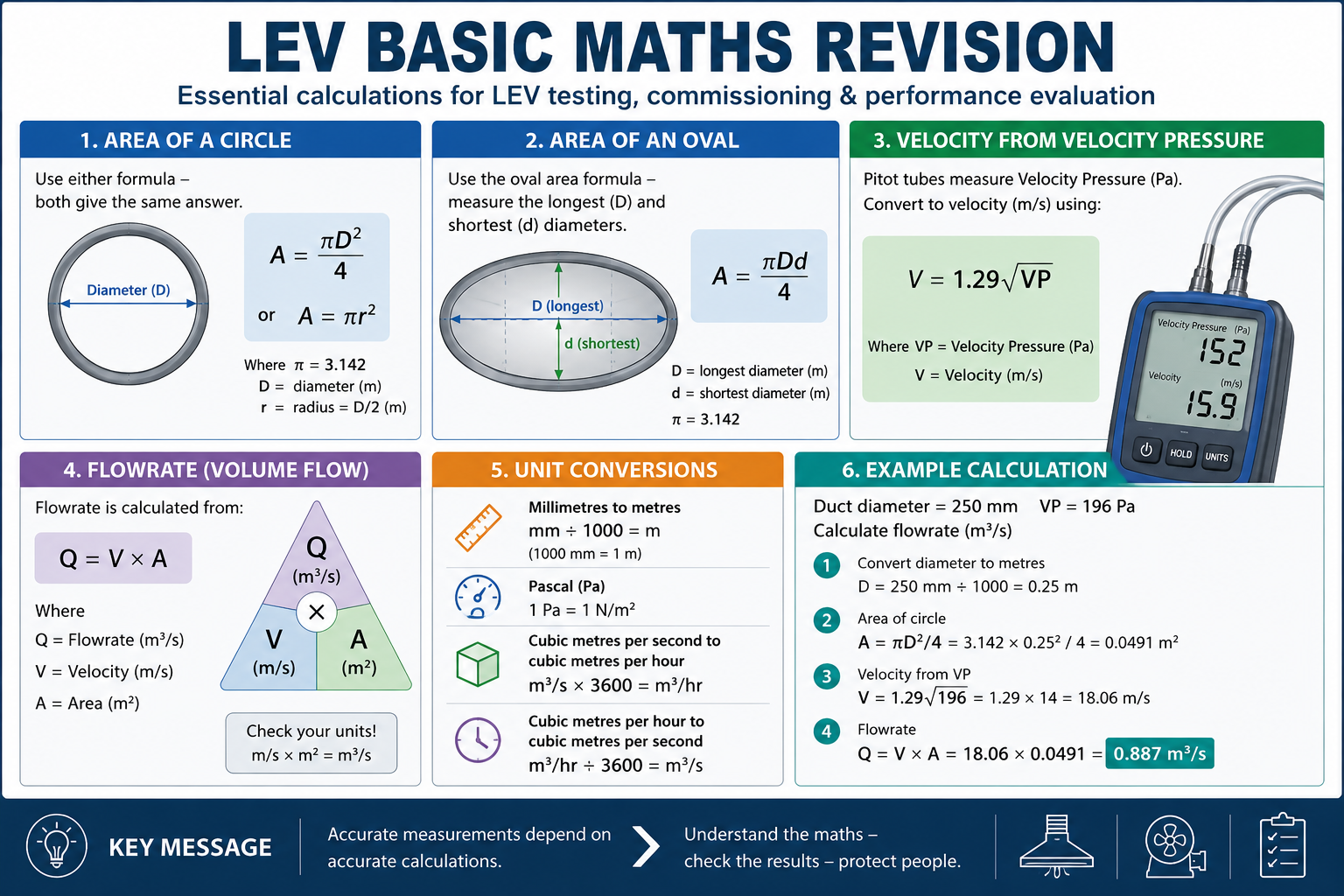
The guide starts with the core equations used throughout LEV work:
- Area of a Circle
- Area of an Oval
- Velocity from Velocity Pressure
- Flowrate (Q = V × A)
and then develops these through worked examples and practical exercises.
Why This Matters
Many LEV measurements ultimately rely upon only a handful of equations:
Circular Duct Area
Used when calculating duct cross-sectional area from internal duct diameter.
Oval Hood Area
Used when assessing capture hoods with elliptical openings.
Velocity Pressure Conversion
Pitot tube traverses measure Velocity Pressure rather than velocity directly. Engineers must convert pressure readings into velocity values using the standard equation:
V = 1.29 √VP
where VP is measured in Pascals.
Flowrate
Flowrate is determined from:
Q = V × A
where:
- Q = Flowrate
- V = Velocity
- A = Area
This relationship forms the basis of most LEV performance assessments.
Common Errors Seen During LEV Training
Typical mistakes observed during training and examinations include:
- Forgetting to convert millimetres into metres
- Using radius instead of diameter
- Forgetting to divide by four in area calculations
- Misreading calculator displays
- Mixing m³/s and m³/hr
- Using incorrect duct dimensions
- Using incorrect pressure units
The revision guide highlights these common errors and provides practical exercises designed to improve confidence before attending formal training.

