HSE HSG103 – Safe Handling of Combustible Dusts
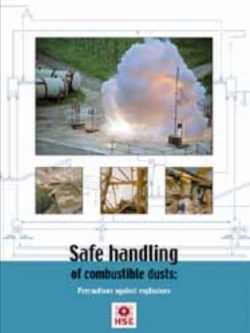
Essential HSE Guidance on Preventing and Mitigating Combustible Dust Explosions
LEVCentral Expert Commentary
Many everyday materials become potentially explosive when converted into fine dust and dispersed in air. Flour, sugar, grain, wood dust, coal dust, plastics, pharmaceuticals and many metal powders can all form explosive dust clouds capable of causing devastating fires and explosions if an ignition source is present.
HSE publication HSG103 – Safe Handling of Combustible Dusts is the UK’s principal guidance document explaining the hazards associated with combustible dusts and the practical measures required to prevent and mitigate dust explosions. Although published to support compliance with the Dangerous Substances and Explosive Atmospheres Regulations (DSEAR), its engineering principles are equally valuable to LEV designers, commissioning engineers, occupational hygienists and Duty Holders responsible for dust extraction systems.
The publication explains why dust explosions occur, how to assess explosion risks and the engineering measures available to prevent ignition or minimise the consequences should an explosion occur. Topics include ignition source control, hazardous area classification, explosion relief venting, suppression systems, containment, explosion isolation and good plant design.
For LEV professionals, HSG103 reinforces an important principle:
Dust extraction systems must not only control exposure—they must also be designed so that they do not create an unacceptable explosion hazard.
Poorly designed extraction systems can inadvertently transport combustible dust into collectors, filters and ductwork where explosive atmospheres may develop. HSG103 therefore complements HSG258 by addressing the additional hazards associated with combustible dust handling rather than exposure control alone.
View HSE Guide
Key Learning Points
The guidance explains:
- Why combustible dusts explode.
- The conditions required for a dust explosion.
- Typical combustible dusts encountered across industry.
- Assessing dust explosion hazards.
- Control of dust cloud formation.
- Elimination and control of ignition sources.
- Hazardous area classification (ATEX zoning).
- Selection of equipment for explosive atmospheres.
- Plant design to minimise explosion risks.
- Explosion relief venting.
- Explosion suppression systems.
- Explosion containment.
- Explosion isolation between interconnected plant.
- Fire hazards associated with combustible dusts.
- Verification before plant is brought into service.
- The importance of maintenance, inspection and housekeeping.
Source Document Information
Organisation: Health and Safety Executive (HSE)
Document: HSG103 – Safe Handling of Combustible Dusts: Precautions Against Explosions
Document Type: Health and Safety Guidance (HSG)
Primary Topics: Combustible Dusts, Dust Explosions, DSEAR, ATEX, Explosion Protection, LEV, Dust Collection
Audience: Duty Holders, LEV Designers, Dust Collection Engineers, Process Engineers, Occupational Hygienists, Health & Safety Professionals, Commissioning Engineers and Plant Managers.
LEVCentral Perspective
HSG103 should be regarded as essential reading for anyone involved in designing, installing or managing LEV systems handling combustible dusts.
Whilst HSG258 focuses on protecting workers from exposure to airborne contaminants, HSG103 addresses an equally important question:
How do we ensure the extraction system itself remains safe?
Dust collectors, cyclones, filters, ductwork and conveying systems may all contain potentially explosive dust-air mixtures during normal operation. Consequently, good LEV design must consider not only airflow and contaminant capture, but also explosion prevention, explosion protection and the potential for explosion propagation throughout interconnected plant.
One of the strengths of HSG103 is that it promotes a layered engineering approach. Preventing combustible dust clouds, eliminating ignition sources, applying explosion protection measures and ensuring competent maintenance all contribute to reducing overall risk. This philosophy mirrors the wider LEVCentral approach of building assurance through multiple complementary layers rather than relying on a single safeguard.
Further Resources
- HSG258 – Controlling Airborne Contaminants at Work
- DSEAR Approved Code of Practice (L138)
- HSE – Prevention of Dust Explosions in the Food Industry
- SHAPA – Dust Testing for DSEAR / ATEX Compliance
- SHAPA – ATEX; Establishing a Basis of Safety
- SHAPA – Practical Guide to Rotary Valves
- SHAPA – Sizing of Explosion Relief Vents
Recommended Learning
- OXY103 Masterclass – DSEAR & ATEX for LEV Specialists
- M505 Control of Hazardous Substances
- M507 Health Effects of Hazardous Substances
- P304 Fundamentals of CoSHH Risk Assessment & Control
- P600 Methods for Testing Performance of LEV
- P601 LEV Thorough Examination & Testing
- P602 LEV Basic Design Principles
- P604 LEV Commissioning & Performance Evaluation
Thought Leadership
HSG103 illustrates that an effective dust extraction system must satisfy two distinct objectives. Firstly, it must capture hazardous airborne contaminants to protect workers’ health. Secondly, it must do so without creating an unacceptable fire or explosion risk within the extraction system itself.
These objectives are complementary rather than competing. Good LEV engineering requires an understanding of contaminant behaviour, airflow and exposure control alongside combustion science, ignition hazards and explosion protection.
By bringing these disciplines together, HSG103 remains one of the most important references available for engineers responsible for combustible dust systems.
Even more than two decades after publication, it continues to provide the foundation for good engineering practice under DSEAR and remains an essential companion to HSG258 for anyone working with combustible dusts.

