HSE Guidance – Working Engineered Stone: Control Silica Risk
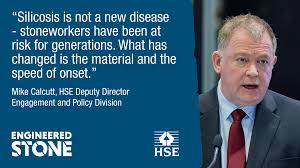
HSE’s Landmark Guidance on Engineered Stone and Silica Dust Control
The Health and Safety Executive (HSE) has published dedicated guidance covering the health risks associated with working engineered stone and the measures required to control exposure to respirable crystalline silica (RCS).
The guidance was developed following increasing international concern regarding severe cases of silicosis and other respiratory diseases affecting workers involved in the fabrication and installation of engineered stone worktops and similar products. HSE subsequently launched a nationwide inspection programme alongside the publication of the guidance.
Engineered stone is commonly used in:
- Kitchen worktops
- Bathroom surfaces
- Commercial interiors
- Reception desks
- Retail fit-outs
- Architectural features
Many engineered stone products contain extremely high levels of crystalline silica, often significantly higher than many natural stone products.
When cut, drilled, ground or polished, engineered stone can generate large quantities of respirable crystalline silica dust capable of penetrating deep into the lungs. Exposure can result in:
- Silicosis
- Chronic Obstructive Pulmonary Disease (COPD)
- Lung cancer
- Permanent lung damage
The guidance explains how employers can comply with COSHH requirements and protect workers from exposure.
This resource is relevant to:
- Occupational Hygienists
- LEV Designers/Commissioners/Testers
- Stone Fabricators
- Kitchen Worktop Manufacturers
- Construction Contractors
- Health & Safety Professionals
- Duty Holders
Source Document
View the HSE guidance here:
Source: Health and Safety Executive (HSE)
Document Type: COSHH Guidance
Status: Current 2026
Last reviewed by LEVCentral: June 2026
LEVCentral Expert Commentary
This guidance represents one of the most significant occupational hygiene developments relating to silica exposure in recent years.
Historically, silicosis has been associated with industries such as mining, quarrying, foundries and construction. However, increasing evidence from around the world has identified engineered stone fabrication as a particularly high-risk activity due to the very high silica content of many products.
Unlike traditional occupational silicosis, which often develops after many years of exposure, some engineered stone workers have developed severe disease after relatively short periods of employment. This has attracted significant attention from regulators, occupational physicians and health professionals internationally.
The HSE guidance makes clear that exposure control must be treated as a priority and that dry cutting of engineered stone should not occur. Research reviewed by HSE found that dry cutting can generate between five and ten times more respirable crystalline silica than equivalent wet methods.
From a LEVCentral perspective, the guidance reinforces a principle familiar to LEV professionals:
Prevention of exposure at source remains the most effective means of protecting workers from silica-related disease.
Key Learning Points
Engineered Stone Can Contain Extremely High Silica Levels
Many engineered stone products contain very high concentrations of crystalline silica, often substantially higher than many natural stones.
Silicosis Can Develop Rapidly
Cases reported internationally have shown that severe silicosis can develop within years rather than decades where exposures are poorly controlled.
Dry Cutting Should Not Be Used
HSE guidance makes clear that dry cutting of engineered stone should not be undertaken because of the substantial increase in respirable silica exposure.
Water Suppression Is Essential
On-tool water suppression significantly reduces airborne silica generation and forms a key element of exposure control.
LEV Still Has an Important Role
Where dust-generating processes occur, effective extraction and ventilation systems remain essential components of a comprehensive control strategy.
HSE’s Control Expectations
Use Lower Silica Products Where Possible
Employers should consider the silica content of materials and select lower-silica alternatives where reasonably practicable.
Eliminate Dry Processing
Dry cutting, grinding and polishing create significantly higher dust exposures and should not be used.
Use Water Suppression
Water-fed tools should be used to reduce airborne silica dust generation at source.
Provide Suitable RPE
Workers should be provided with suitable respiratory protective equipment and appropriate face-fit arrangements where required.
Health Surveillance Is Required
Where workers are regularly exposed to respirable crystalline silica, health surveillance should be implemented in accordance with COSHH requirements.
Why This Matters to LEV Professionals
The engineered stone sector provides a powerful example of why exposure control cannot rely solely on personal protective equipment.
Effective control requires a hierarchy of measures including:
- Material selection
- Process design
- Water suppression
- LEV systems
- Housekeeping
- Health surveillance
- Occupational hygiene monitoring
For LEV designers and TExT engineers, the guidance reinforces the importance of ensuring that extraction systems are designed, maintained and tested to control silica-containing dust effectively.
It also highlights the growing importance of occupational hygiene considerations during commissioning and verification activities.
Relationship to Other Key Silica Resources
This guidance should be read alongside:
- HSG258 – Controlling Airborne Contaminants at Work
- EH40 Workplace Exposure Limits
- HSE Silica Essentials Guidance
- APPG Report on Silicosis
- HSE Brick, Tile and Ceramics Silica Guidance
- HSE INDG463 “Control of Exposure to Silica Dust”
- BOHS Silica Dust: Risks When Working with Engineered Stone
Together these resources provide a comprehensive framework for managing respirable crystalline silica exposure across multiple industries.
Recommended Learning
- M200 Basic Principles of Occupational Hygiene
- M501 Measurement of Hazardous Substances
- P600 Methods for Testing Effectiveness of LEV
- P601 Thorough Examination and Testing of LEV Systems
- P602 LEV Design Principles
- P603 CoSHH PPE
- P604 Performance Evaluation and Management of LEV Systems
Thought Leadership
- The New Face of Silicosis
- Engineering Controls and Occupational Disease Prevention
- Defensible Exposure Control Strategies
- Why Silica Remains One of Industry’s Biggest Health Risks
LEVCentral Observation
The publication of dedicated HSE guidance for engineered stone marks a significant moment in occupational health regulation.
It reflects growing evidence that engineered stone fabrication can present some of the highest silica exposure risks encountered in modern industry.
For occupational hygienists, LEV professionals and duty holders, the message is clear: silica-related disease remains entirely preventable, but only where robust exposure controls are implemented and maintained.
The guidance serves as a timely reminder that effective engineering controls remain one of the most powerful tools available for protecting worker health.

