HSA Ireland – Local Exhaust Ventilation (LEV) Guidance
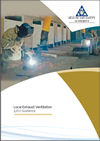
Ireland’s Equivalent of HSG258 – A Comprehensive Guide to Designing, Commissioning and Managing LEV Systems
LEVCentral Expert Commentary
For anyone familiar with HSG258 – Controlling Airborne Contaminants at Work, this publication will feel immediately familiar.
The Health and Safety Authority (HSA) Ireland’s Local Exhaust Ventilation (LEV) Guidance is widely regarded as the Irish equivalent of HSG258. Published in 2014, it provides comprehensive guidance on the design, installation, commissioning, operation, maintenance and statutory examination of Local Exhaust Ventilation systems. Although written to support Irish health and safety legislation, the engineering principles are almost identical to those applied throughout the UK under COSHH and HSG258.
One of the strengths of the document is that it follows the complete lifecycle of an LEV system. It begins by explaining the health hazards associated with airborne contaminants before progressing through risk assessment, hood selection, ductwork, air cleaners, fans, commissioning, user manuals, log books, routine user checks, maintenance and statutory Thorough Examination and Testing. In doing so, it provides employers with a clear understanding of what is required to ensure an LEV system continues to provide adequate control throughout its working life.
For LEV engineers, occupational hygienists and Duty Holders, this publication is one of the best freely available references outside the UK and demonstrates how closely Irish and UK approaches to LEV engineering align.
View HSA Guide
Key Learning Points
The guidance covers:
- What Local Exhaust Ventilation (LEV) is.
- Types of airborne contaminants.
- Applying the Hierarchy of Control.
- The legal duties of employers.
- Risk assessment.
- Types of LEV systems.
- LEV hoods and enclosures.
- Airflow principles.
- Ductwork design.
- Air cleaners and filtration.
- Fan selection.
- System discharge.
- Installation requirements.
- Commissioning.
- LEV User Manuals.
- LEV Log Books.
- Routine operator checks.
- Planned maintenance.
- Thorough Examination and Testing.
- Competence requirements.
- Typical LEV faults.
- Responsibilities of employers, designers, installers, examiners and users.
The LEV Lifecycle
Like HSG258, the HSA guidance emphasises that effective LEV depends on managing the entire lifecycle of the system.
| Stage | Objective |
|---|---|
| Risk Assessment | Identify airborne contaminants and determine whether LEV is required. |
| Design | Select an LEV system capable of achieving adequate control. |
| Installation | Ensure the system is installed in accordance with the design specification. |
| Commissioning | Demonstrate and document that the installed system performs as intended. |
| User Manual & Log Book | Provide operators with instructions and establish ongoing management records. |
| Routine User Checks | Identify faults before they become serious. |
| Maintenance | Keep the system operating effectively. |
| Thorough Examination & Testing | Independently verify continued performance at statutory intervals. |
This lifecycle approach mirrors the philosophy promoted by HSG258 and reinforces that LEV is an ongoing management system rather than a one-off engineering installation.
Source Information
Organisation: Health and Safety Authority (HSA), Ireland
Document: Local Exhaust Ventilation (LEV) Guidance
Publication Year: 2014
Document Type: Comprehensive Guidance Document
Primary Topics: Local Exhaust Ventilation, LEV Design, Commissioning, Maintenance, User Checks, Thorough Examination and Testing, Competence, Occupational Hygiene.
Audience: Employers, Duty Holders, LEV Designers, LEV Installers, LEV Commissioning Engineers, LEV Test Engineers, Occupational Hygienists, Health & Safety Professionals and Facilities Managers.
LEVCentral Perspective
Having reviewed both documents extensively, it is fair to describe the HSA publication as Ireland’s HSG258.
The structure, terminology and engineering principles are remarkably similar. Both documents emphasise:
- controlling contaminants at source;
- selecting appropriate hoods;
- designing effective duct systems;
- commissioning new installations;
- providing User Manuals and Log Books;
- undertaking routine user checks;
- maintaining systems properly; and
- carrying out periodic Thorough Examination and Testing by competent persons.
There are, of course, some differences. The legal references reflect Irish legislation, and the guidance is framed around the Safety, Health and Welfare at Work Act and associated Irish regulations rather than COSHH. However, the engineering advice is fundamentally the same.
One particularly welcome feature is the emphasis placed on commissioning. The HSA recognises that an LEV system cannot be managed effectively unless there is documented evidence of its original performance. This aligns closely with the principles promoted in the OXYL8 Defensible Commissioning Framework™, where commissioning establishes the performance benchmark against which future examinations are assessed.
The guidance also places considerable emphasis on competence, recognising that designers, installers, examiners and users all have distinct responsibilities that require appropriate knowledge, training and experience.
Further Resources
For readers working in the UK or Ireland, the following publications complement the HSA guidance:
- HSG258 – Controlling Airborne Contaminants at Work (HSE, UK)
- INDG408 – Clearing the Air: A Simple Guide to Buying and Using LEV
- HSE LEV Frequently Asked Questions
- HSA – Crystalline Silica Dust Information Sheet
- HSA – Wood Working Information Sheet
- HSA – Isocyanates Information Sheet
- HSG103 – Safe Handling of Combustible Dusts
Recommended Learning
- M200 Basic Principles in Occupational Hygiene
- M501 Measurement of Hazardous Substances
- M505 Control of Hazardous Substances
- M507 Health Effects of Hazardous Substances
- P304 Fundamentals of CoSHH Risk Assessment & Control
- P603 CoSHH PPE
- P600 Methods for Testing Performance of LEV
- P601 LEV Thorough Examination & Testing
- P602 LEV Basic Design Principles
- P604 LEV Commissioning & Performance Evaluation
Thought Leadership
Few guidance documents illustrate the complete management of LEV systems as effectively as the HSA’s LEV Guidance.
Perhaps its greatest contribution is demonstrating that good LEV engineering is internationally consistent. Whether operating under Irish legislation or UK COSHH Regulations, the fundamental principles remain unchanged: understand the hazard, control contaminants at source, commission systems properly, document performance, train users, maintain equipment and verify ongoing effectiveness through periodic examination and testing.
From a LEVCentral perspective, the HSA guidance deserves to be much better known within the UK LEV community. It is not a replacement for HSG258, but an excellent companion publication that reinforces the same engineering philosophy from a different regulatory perspective.
For anyone seeking to deepen their understanding of LEV management, it is one of the most comprehensive freely available guidance documents in Europe and a valuable addition to every LEV professional’s reference library.

